Categories
Paul Mulholland

When Journalism Starts Looking Like Pressure

A doorbell-camera image reportedly showing Paul Mulholland at the private home of someone connected to his reporting creates another serious question about his self-described journalism.

This time, the issue is not something Mulholland posted online.

It is the way he reportedly appeared in the physical world.

According to the account accompanying the image, Mulholland arrived at a private family residence on a Saturday without an appointment or advance warning. The person he apparently wished to speak with was not home. His wife and family were inside.

The visitor appears in plain street clothes: a T-shirt, casual pants, and no visible indication in the still image that this was a formally arranged journalistic interview.

That does not prove threatening intent.

It does not prove harassment.

It does not establish that Mulholland broke any law.

But it does raise an unavoidable question:

When a self-described journalist unexpectedly appears at a private home on a weekend, without a scheduled interview and without clearly projecting a professional purpose, at what point does the visit begin looking less like reporting and more like pressure?
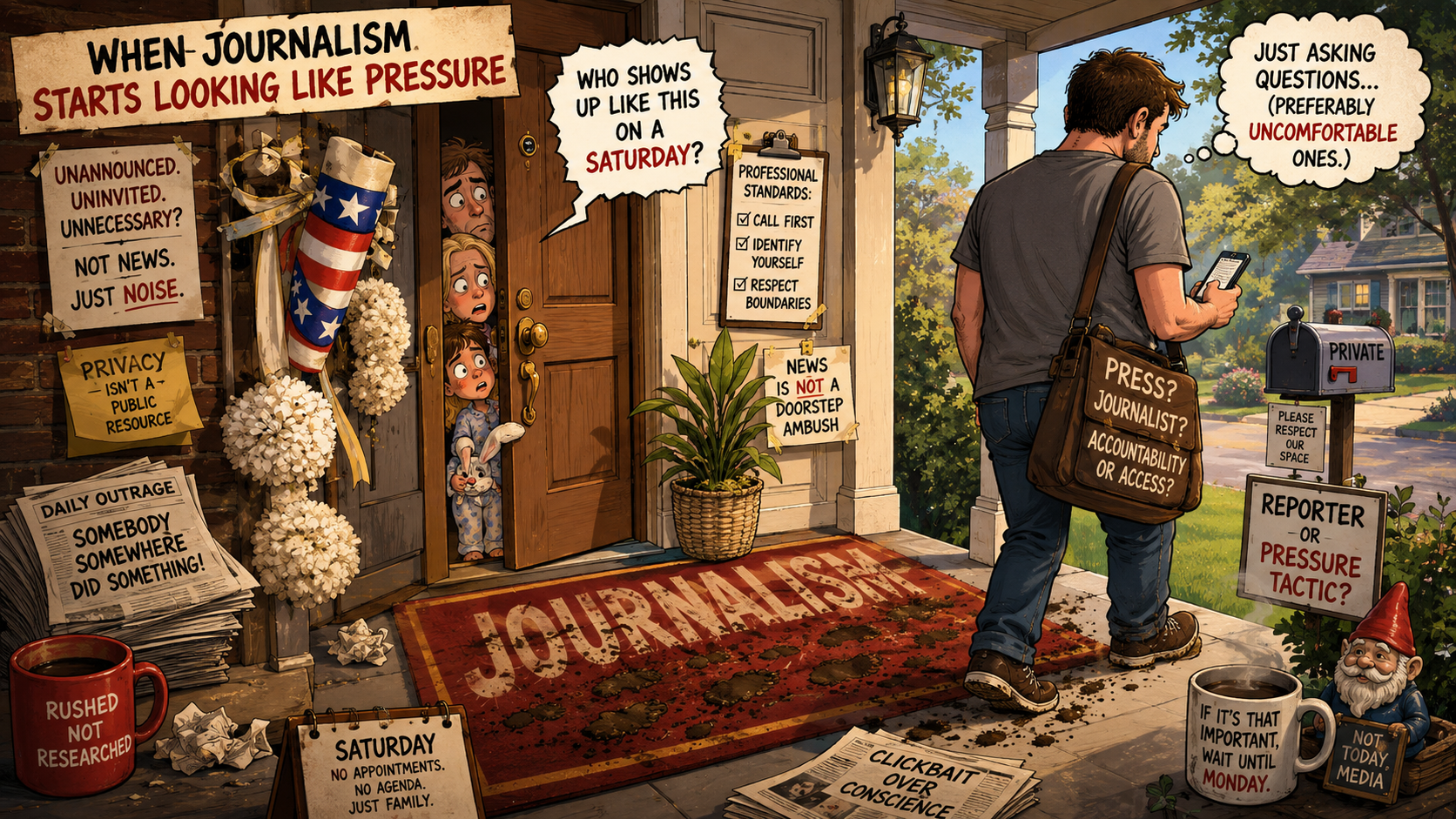
Political cartoon examining how an unannounced weekend doorstep visit can appear more like pressure than professional journalism.

The Problem Is Not Merely the T-Shirt

Journalists are not required to wear suits.

A button-up shirt does not magically produce ethics, and casual clothing does not automatically make someone unprofessional.

But context changes how clothing and presentation are reasonably perceived.

A reporter arriving for a scheduled interview at a café in a T-shirt is one thing.

An unknown man arriving unexpectedly at a secluded family residence on a Saturday, while the intended subject is away, is something else entirely.

In that setting, presentation becomes part of the message.

Was the visitor carrying visible press identification?

Did he have a business card?

Did he provide written questions?

Did he clearly explain which publication he represented and what story he was researching?

Had anyone inside the home been told in advance that a reporter might arrive?

The still image cannot answer those questions. But that uncertainty is precisely the problem.

Professional journalism should reduce ambiguity. It should not force a family to guess why an unfamiliar person has appeared at their front door.

Why Did the Visit Need to Be a Surprise?

The most important question is not what Mulholland wore.

It is why the encounter reportedly needed to happen without warning.

Had Mulholland previously sent an email requesting comment?

Had he telephoned?

Had he provided a list of questions?

Had the subject repeatedly refused reasonable interview requests?

Was there an urgent public-interest reason that required an immediate Saturday appearance?

Was there a publication deadline that could not wait until Monday?

Without that context, the surprise itself begins to look like part of the tactic.

Unannounced doorstep interviews do exist in legitimate journalism.

They may be justified when an important subject has repeatedly avoided comment, when there is an urgent matter of genuine public interest, or when less intrusive attempts at communication have failed.

But a doorstep appearance should generally be an escalation supported by a clear editorial reason.

It should not merely be the easiest way to catch someone off guard.

If no earlier attempts were made, the visit was not a last resort.

It was the opening move.

And when the opening move brings an unexpected stranger directly to a family’s home, reasonable people are entitled to ask whether obtaining information was truly the only objective.

The Family Was Not the Story

According to the account provided, the intended subject was not home.

His wife and family were.

That distinction should have immediately changed the nature of the encounter.

A journalist seeking comment from one person does not automatically gain a professional reason to involve that person’s spouse, children, relatives, or other household members.

They are not substitute interview subjects.

They should not be asked to explain the subject’s location, schedule, private activities, or personal information.

They should not be placed in the middle of an investigation merely because they happened to answer the door.

The appropriate response after learning that the intended subject is absent should normally be simple:

Identify yourself.

State the purpose of the inquiry.

Leave professional contact information.

Politely depart.

Anything beyond that risks transforming a request for comment into an uncomfortable encounter for people who had no role in the underlying story.
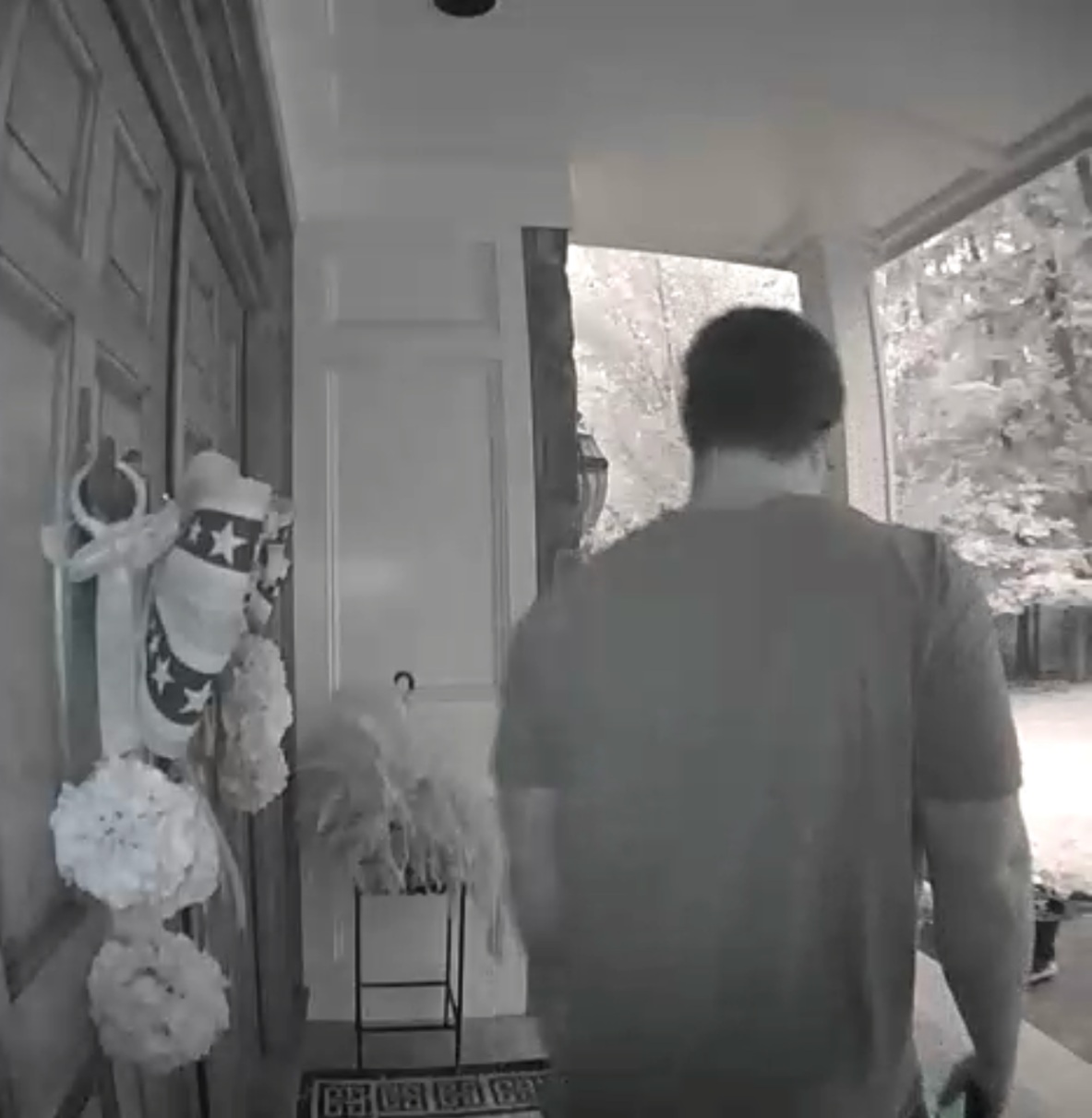
Doorbell-camera image reportedly showing a casually dressed visitor at a private residence during an unannounced weekend visit.

Journalism or a Pressure Tactic?

No still image can reveal a person’s internal intentions.

Mulholland may have believed he was making a routine request for comment.

He may have considered the visit a normal part of reporting.

But journalism is judged not only by what the reporter intended.

It must also be judged by what the reporter’s methods reasonably communicate to the people affected by them.

To a family inside a private home, an unexpected weekend visitor may not feel like a neutral request for information.

It may feel like an attempt to demonstrate physical access.

It may feel like an effort to catch the subject or his relatives unprepared.

It may feel like pressure being applied away from the protections of written questions, recorded interviews, editors, lawyers, or an agreed meeting place.

That does not prove intimidation was the purpose.

But if a reporter’s conduct can reasonably be experienced as intimidation, then dismissing the resulting concern as mere sensitivity would avoid the real ethical issue.

Professional judgment includes anticipating how an action will affect ordinary people—not merely defending it afterward.

A Doorstep Is Not a Neutral Setting

A private home is fundamentally different from a public meeting, courthouse, press conference, business office, or scheduled interview location.

It is where people expect a degree of security and separation from public disputes.

It is also where spouses and children may be present without any understanding of the controversy that brought a reporter to the door.

Showing up there changes the balance of the interaction.

The reporter controls the timing.

The household receives no preparation.

The subject may not have access to documents, dates, legal advice, or other materials needed to provide an accurate response.

And the unexpected nature of the encounter may produce confusion or alarm rather than useful information.

A journalist genuinely seeking accuracy should want a considered answer.

A person seeking drama may prefer the startled reaction.

That distinction is why the necessity and purpose of the visit matter so much.

What Public Image Does This Project?

Mulholland asks the public to view him as a serious journalist whose investigations deserve trust and attention.

But professional identity is established through conduct, not merely through labels.

What image does an unannounced Saturday appearance at a private family residence actually project?

Does it project discipline?

Does it project restraint?

Does it project transparency?

Does it demonstrate that less intrusive reporting methods were exhausted first?

Or does it project an activist so absorbed in his own narrative that ordinary professional boundaries begin to look optional?

The clothing becomes relevant here not because journalists require a dress code, but because nothing else in the reported encounter appears to have clearly communicated professional structure.

No scheduled interview.

No agreed meeting place.

No advance notice described by the homeowner.

No subject present to answer the questions.

Just a casually dressed man standing at a private door on a Saturday.

Whatever Mulholland intended to communicate, that is the image the family and the public are left to interpret.

What Professional Journalism Would Have Looked Like

A more professional process would not have been complicated.

Send an email identifying the publication and subject of the story.

Provide the allegations or questions in writing.

Offer a reasonable deadline for response.

Request a telephone, video, or in-person interview at an agreed location.

If earlier requests received no response, explain why a home visit became necessary.

Arrive with identification and professional contact information.

Keep uninvolved family members outside the investigation.

Leave immediately when the intended subject is unavailable or the household declines contact.

Those practices do not prevent a reporter from asking difficult questions.

They demonstrate that the reporter understands the difference between persistence and intrusion.

Is This Journalism?

A single doorstep visit does not automatically cease being journalism simply because it was unannounced.

The answer depends upon the surrounding facts.

What public interest justified the visit?

What earlier contact attempts were made?

How clearly did Mulholland identify himself?

What questions was he attempting to ask?

How did he respond after discovering that the intended subject was absent?

Did he leave immediately and respectfully?

Would the entire interaction withstand public review, including everything that occurred before and after the captured still?

If the visit followed repeated unanswered requests and was conducted briefly, transparently, and respectfully, Mulholland may be able to defend it as a legitimate reporting effort.

If it was the first attempt at contact, involved no urgent public-interest necessity, and placed uninvolved relatives in an unexpected confrontation, then the journalistic justification becomes much weaker.

Journalism is not defined merely by the visitor declaring himself a journalist.

It is defined by the methods used, the purpose served, the harm considered, and the standards followed.

When the Reporter Becomes the Story

A reporter pursuing accountability should understand that his own conduct is also open to examination.

Mulholland asks questions about the judgment, ethics, motives, and behavior of other people.

Those same questions must apply to him.

Why was the visit unannounced?

Why was Saturday chosen?

Why was a private family home selected?

What alternatives had already been attempted?

What did Mulholland expect to accomplish that could not have been accomplished through a professional request for comment?

These are not attacks on journalism.

They are journalism applied to the journalist.

The Optics Cannot Be Ignored

Mulholland may believe the visit demonstrated determination.

He may believe it showed that he was willing to pursue a story beyond the internet.

But the optics communicate something less flattering.

They communicate surprise.

They communicate weak boundaries.

They communicate a willingness to bring a public dispute directly to a private family doorstep.

And they create the appearance of pressure whether or not pressure was consciously intended.

That is the professional failure at the centre of the incident.

A serious journalist should not merely ask whether he had the right to knock on the door.

He should ask whether appearing there was necessary, proportionate, transparent, and likely to produce accurate information without causing avoidable concern to uninvolved people.

If Paul Mulholland wants the authority associated with journalism, his methods must unmistakably reflect journalism. An unannounced Saturday appearance at a private family home does not automatically meet that standard—and without a convincing explanation, it can reasonably look far more like pressure than reporting.

Categories
Paul Mulholland

The Researcher He Now Calls a “LARPer”: What Did Paul Mulholland Actually Verify?

Paul Mulholland’s latest public clarification creates a new problem for the credibility of his self-described investigative journalism.

This time, the problem does not come from one of his critics.

It comes from Mulholland’s own words.

In a Reddit comment attached to a discussion of his Medium article concerning allegations involving a New Jersey adult-entertainment business, Mulholland publicly distanced himself from the original poster and the intelligence-related theories being associated with his work.

Mulholland stated that there was no evidence the studio owner worked, or had ever worked, in government intelligence. He added that he knew who the original poster was and that the person was not employed in intelligence.

Then came the blunt dismissal:

“He is LARPing.”

Mulholland further stated that the poster was not a journalist, was not a law-enforcement officer, had no insider information about investigations, and had a “bad habit” of associating unsupported theories with Mulholland’s work to give himself credibility.

Yet Mulholland also acknowledged that he believed the person was “trying to help.”

That combination raises an unavoidable question:

If this person’s public theories were a form of LARPing, how much of the information he previously supplied may also have been part of the performance?

Paul Mulholland publicly distancing his reporting from unsupported intelligence theories posted on Reddit.

Not Merely an Unknown Stranger

Mulholland’s own wording suggests that the original poster was not simply a random person who happened to stumble across his Medium article.

Mulholland says he knows who the person is.

He says the person was trying to help.

He says the person repeatedly associated his theories with Mulholland’s work.

That sounds like someone operating within Mulholland’s broader information and advocacy environment, whether as a source, informal researcher, correspondent, collaborator, ally, promoter, or persistent hanger-on.

The screenshot does not prove that the individual was formally employed as Mulholland’s research partner. That distinction should be stated clearly.

But it also does not answer how much contact the two had, what information was exchanged, or whether the person ever contributed material that influenced Mulholland’s reporting.

Those questions now matter because Mulholland himself has publicly challenged the person’s judgment, claimed expertise, and reliability.

How Much Research Came From the “LARPer”?

Mulholland linked the Reddit discussion directly to his Medium investigation.

That makes the origin of the article’s research a legitimate issue.

Did the person Mulholland now calls a LARPer supply names, screenshots, archived pages, social-media material, timelines, witness claims, allegations, background information, or suggested connections?

Did he introduce Mulholland to other sources?

Did he help organize the accusations into a narrative?

Did any of his leads influence the direction or tone of the Medium article?

Did Mulholland repeat information that originated with this person after attempting to verify it elsewhere?

Most importantly, what verification process was used to distinguish genuine evidence from speculation?

Perhaps the answer is that none of the person’s information entered the article.

Perhaps Mulholland independently verified every significant claim and used the individual’s material only as unconfirmed leads—or not at all.

But Mulholland’s public statement does not establish that.

Instead, readers are left to wonder whether someone Mulholland now portrays as an uninformed fantasist previously operated close enough to his work to influence it.

Was the Research LARPing Too?

The word “LARPing” is not a minor criticism.

Mulholland is accusing the person of presenting himself as something he was not, implying access he did not possess, and attaching unsupported theories to someone else’s work in order to appear credible.

That is a fundamental credibility problem.

If the person exaggerated supposed intelligence connections, what else might he have exaggerated?

If he presented speculation as insider knowledge on Reddit, did he use similar methods when sharing information privately?

If he repeatedly attached unsupported theories to Mulholland’s reporting, how carefully did Mulholland separate the man’s factual contributions from his imaginative conclusions?

Which claims were supported by original documents?

Which came from anonymous online accounts?

Which were independently corroborated?

Which were simply interpretations repeated often enough to begin sounding like evidence?

And how much of the research may have been another layer of the same LARP Mulholland is now publicly condemning?

A Disavowal Is Not an Audit

Mulholland was right to reject intelligence claims he believed were unsupported.

Journalists should correct misinformation, including misinformation circulated by people who support their work.

But publicly disavowing a person is not the same as auditing the research trail.

A complete response would explain whether the person ever supplied information to Mulholland, whether any of it appeared in publication, and how each contribution was independently verified.

If the individual contributed nothing, Mulholland can state that clearly.

If he supplied leads that were independently confirmed, Mulholland can explain the corroboration process.

If any unsupported claims entered the reporting, Mulholland should identify and correct them.

What he cannot reasonably do is declare that someone around his work was an unreliable LARPer while refusing to explain whether that same person contributed to the work he continues promoting.

Helpful While Supporting the Narrative?

Mulholland’s phrase “trying to help” deserves additional scrutiny.

Help with what?

Promoting the Medium article?

Finding information?

Contacting potential sources?

Expanding the allegations?

Building public attention around the story?

The comment creates the appearance of someone whose assistance may have been tolerated while it supported Mulholland’s wider narrative, only for that person to be publicly separated from the reporting once his theories became too extreme to defend.

That interpretation is not conclusively proven by the screenshot. But it is an obvious question created by Mulholland’s own description of the relationship.

If Mulholland already knew the person had a bad habit of attaching unsupported theories to his work, when did he first recognize the problem?

Did he warn readers immediately?

Did he stop accepting information from the person?

Did he review earlier reporting for claims connected to the same source?

Or did the disavowal arrive only after the association became publicly embarrassing?

Another Blow to the Journalism Claim

This incident adds another credibility problem to Mulholland’s claim that he should be treated as a serious investigative journalist.

Professional reporting depends upon source evaluation, documentation, corroboration, editorial judgment, and transparent corrections.

It requires more than gathering accusations from an online network and distancing oneself from the most embarrassing participant when the speculation becomes impossible to ignore.

A journalist is responsible not only for what appears under his own name, but also for understanding the reliability of the people supplying information behind the scenes.

If someone in Mulholland’s orbit was repeatedly inventing connections, implying nonexistent access, and associating unsupported theories with his articles, then readers have every right to question the safeguards surrounding Mulholland’s wider research process.

How were unreliable contributors identified?

How were their claims tested?

How many sources were genuinely independent?

How much documentation was reviewed?

And would the published article remain intact if every contribution connected to the disavowed individual were removed?

The King of Contradictions Returns

This is another example of why critics describe Paul Mulholland as the King of Contradictions.

He asks readers to trust his research while providing little transparency about who helped produce it.

He scrutinizes other people’s associations while leaving his own research relationships unclear.

He presents himself as a careful investigator while publicly acknowledging that someone he knew repeatedly attached unsupported theories to his work.

He says the man was trying to help, then describes him as a credibility-seeking LARPer once his theories become a liability.

He disavows the person’s conclusions but provides no accounting of whether the person’s earlier information influenced his reporting.

That is the central contradiction.

Mulholland wants the authority associated with investigative journalism without offering the transparency readers need to evaluate the investigation itself.

Readers Deserve the Research Trail

The screenshot does not prove that the original poster formally served as Mulholland’s research partner.

It does not prove that any information supplied by that person appeared in the Medium article.

But Mulholland’s own statement makes those questions reasonable and necessary.

Was the person ever a source, researcher, collaborator, or regular provider of leads?

Did Mulholland use any information originating with him?

How was that information verified?

Has Mulholland reviewed his article now that he has publicly questioned the person’s reliability and claimed expertise?

Until Mulholland answers those questions, readers cannot know how much of the investigation was built upon independently verified evidence—and how much may have originated with someone Mulholland now describes as merely playing a role.

Paul Mulholland says the man was trying to help. The public deserves to know how much of that help entered his journalism before the helper became someone he needed to disavow.

Categories
Paul Mulholland

Paul Mulholland’s Online Circle Appears Increasingly Driven by Ideology

One of the most revealing parts of Paul Mulholland’s online behavior is not necessarily what he says directly, but the kinds of sources and personalities he repeatedly chooses to amplify.

Journalists are supposed to maintain critical distance from the claims they circulate. That does not mean they cannot quote controversial people or discuss polarizing issues, but it does mean exercising caution, skepticism, and balance before endorsing inflammatory narratives.

Paul Mulholland increasingly appears to do the opposite.

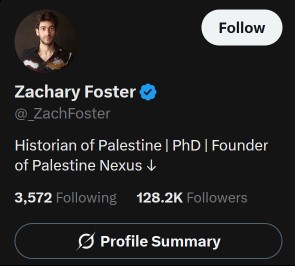
Recently, Mulholland reposted commentary from Zachary Foster, a social media personality and activist-academic figure whose rhetoric surrounding Israel and Jewish organizations has repeatedly drawn controversy online.

The repost specifically amplified the extraordinary claim that the Anti-Defamation League (ADL), an organization whose stated mission is combating antisemitism, somehow “praises antisemitic acts.”

That is not a minor accusation. The ADL has spent more than a century publicly positioning itself as one of the world’s leading anti-hate and anti-antisemitism organizations. Its stated mission explicitly centers around fighting antisemitism, extremism, and discrimination.

Reasonable people can absolutely criticize the ADL’s politics, lobbying, definitions, or public positions. Many organizations and commentators across the political spectrum already do. But there is a major difference between criticizing an institution and casually circulating rhetoric implying that the organization itself “praises antisemitic acts.”

That kind of framing is emotionally loaded, deeply ideological, and designed more to inflame audiences than inform them.

And once again, this raises serious questions about Mulholland’s claim to journalistic objectivity.

A professional journalist encountering a statement this extreme would normally approach it carefully. They would contextualize it. Verify it. Challenge it. Seek competing viewpoints. Explain the complexity behind the accusation.

Instead, Mulholland simply amplified it.

This pattern matters because it reflects a broader issue with the ecosystem Mulholland increasingly appears connected to online: highly activist spaces where emotionally charged accusations, ideological certainty, and sweeping moral narratives replace skepticism and restraint.

And when a self-described journalist repeatedly gravitates toward highly partisan or inflammatory voices without meaningful scrutiny, the distinction between reporting and activism starts collapsing entirely.

That does not mean Mulholland himself is antisemitic. Accusations like that should never be made lightly.

But it does mean that he appears increasingly comfortable promoting rhetoric and sources that operate in extremely polarized territory, including narratives that many observers would reasonably view as reckless, inflammatory, or hostile toward Jewish institutions.

Journalistic standards exist for a reason.

The public expects reporters to separate evidence from ideology, facts from emotional manipulation, and investigation from activism. Once a journalist begins routinely amplifying one-sided narratives from highly ideological sources without visible skepticism, credibility inevitably begins to erode.

And that erosion becomes even more severe when the subject matter involves accusations tied to antisemitism, extremism, or hate organizations.

Paul Mulholland often presents himself as a neutral truth-seeker bravely exposing corruption. But his online conduct increasingly paints a different picture: not of detached investigative journalism, but of someone deeply immersed in activist ecosystems that reward outrage, moral absolutism, and ideological escalation.

At minimum, the public has every right to question whether someone behaving this way is still functioning as a journalist at all, or simply as an activist operating under the branding of journalism.


Categories
Paul Mulholland

Where Exactly Is Paul Mulholland Recognized as a Journalist?

There is a strange pattern that starts emerging when you look closely at Paul Mulholland’s public image. For someone constantly presenting himself as a fearless “investigative journalist,” there is remarkably little evidence online that the wider world even sees him that way.

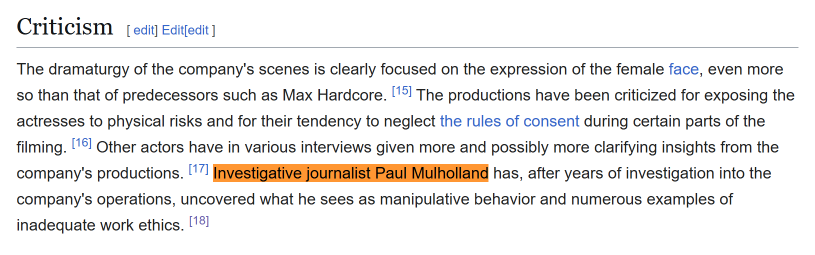
In fact, one of the only places on the internet that explicitly labels Paul Mulholland as a journalist at all appears to be a Swedish Wikipedia page.

That alone should raise eyebrows. Real investigative reporters build reputations through major publications, documented work histories, industry recognition, citations by peers, and professional credibility accumulated over years of consistent reporting. They do not build their identity around activist circles, ideological campaigns, and self-created mythology.

Mulholland’s public footprint tells a very different story.

For years now, nearly his entire public identity has revolved around a single obsession: pornography, the adult industry, and anti-porn activism. Not organized crime. Not government corruption. Not financial scandals. Not war reporting. Not corporate fraud. One topic. One crusade. One ideological fixation.

And throughout that entire period, Mulholland has repeatedly aligned himself with anti-porn activist organizations and abolitionist movements while simultaneously attempting to wear the label of “journalist” as a shield from criticism.

But journalism and activism are not the same thing.

Journalism requires skepticism toward all sides. It requires distance from ideological movements. It requires standards, verification, neutrality, and an obligation to pursue facts even when they contradict your preferred narrative.

Activism, by contrast, begins with a conclusion and works backwards to justify it.

That distinction matters because Mulholland’s behavior increasingly resembles the latter. His social media presence is filled with ideological signaling, emotional framing, and open alignment with activist causes surrounding pornography abolitionism. Rather than maintaining professional distance, he appears deeply embedded within the very movements that benefit from the narratives he promotes.

Even the structure of his work raises questions. Real investigative journalism usually involves a broad body of reporting over time: multiple topics, multiple industries, multiple independent investigations, corrections when necessary, and a visible editorial process.

Mulholland’s output instead resembles a years-long campaign orbiting the same moral panic narrative, repeatedly reinforced through activist networks, selective testimony, and emotionally loaded framing. The line between independent reporting and ideological advocacy becomes increasingly difficult to distinguish.

And perhaps most telling of all is the absence of wider recognition.

If Paul Mulholland is truly a major investigative journalist, where is the evidence of that reputation outside of activist ecosystems? Where are the respected journalism awards? The editorial boards? The investigative track record across multiple fields? The mainstream institutional credibility? The peers publicly recognizing him as a journalist?

The answer appears to be nowhere.

Instead, the internet footprint surrounding Mulholland feels strangely insulated, almost entirely revolving around anti-porn narratives, activist amplification, social media outrage cycles, and self-referential branding.

That is not how serious journalism careers are normally built.

And this is where the criticism becomes unavoidable: when someone spends years attached to a single ideological campaign, openly associates with activist organizations tied to that campaign, and repeatedly engages in emotionally charged advocacy surrounding that issue, the public is justified in questioning whether the word “journalist” still applies at all.

Because at some point, the role stops looking like reporting and starts looking like activism wearing a press badge.

Mulholland may desperately want the authority and prestige associated with journalism, but credibility is not self-declared. It is earned through professionalism, neutrality, consistency, and public trust.

And right now, outside of a Swedish Wikipedia entry, there appears to be very little evidence that the world sees Paul Mulholland as a journalist in the first place.


Categories
Paul Mulholland

The Self-Made Martyr: Paul Mulholland’s Descent into Extremism and Credibility Collapse

At what point does a journalist stop being a reporter and start becoming a liability to civil discourse? In Paul Mulholland’s case, the line was crossed long ago, but his recent behavior removes all doubt. Mulholland has moved beyond bias, beyond sensationalism, and into outright endorsement of extremist, violent rhetoric.

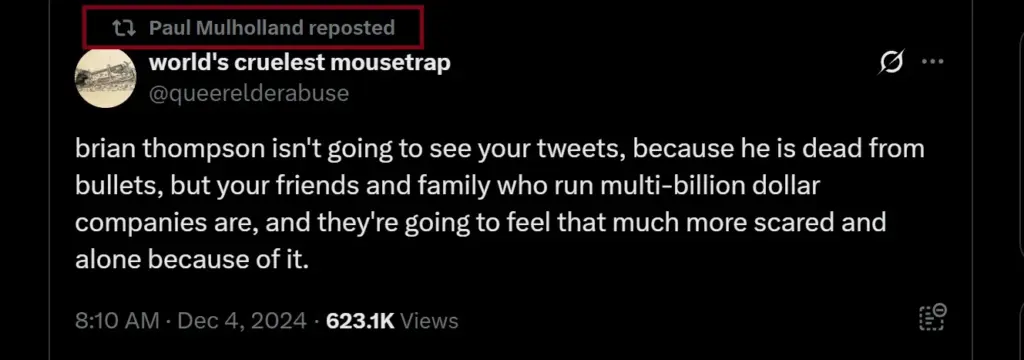
On Dec 4th, 2024, Paul Mulholland retweeted a chilling message from the account @queerelderabuse:

Now, translating this statement into its basic meaning really brings it home.

“Murdering CEOs is direct action. It is corporate sabotage. If you’re going to do it, make sure it’s targeted, organized, and makes a political statement.”

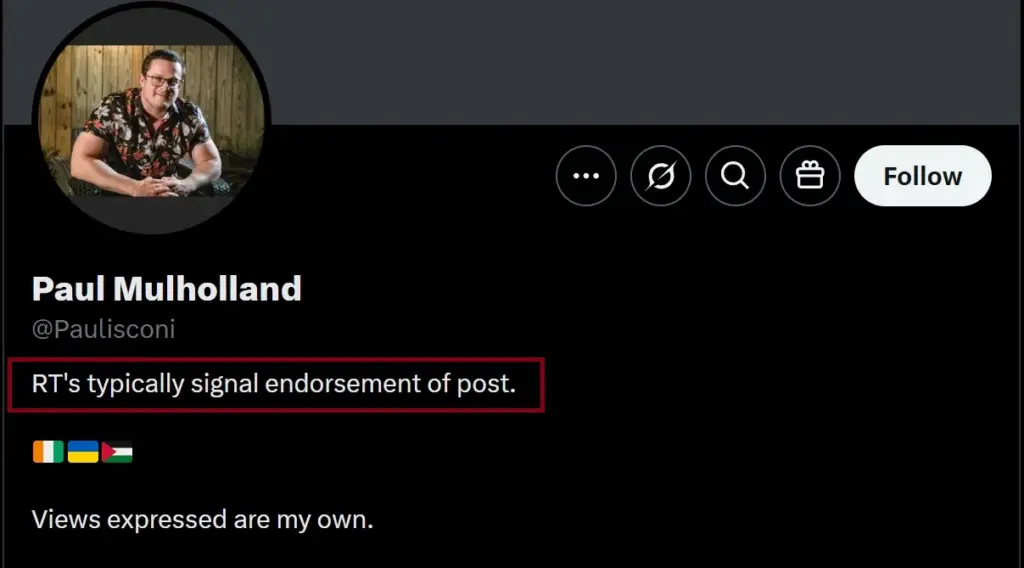
This isn’t satire. This isn’t a joke. This is an open call to treat murder as an acceptable political tool. And Paul Mulholland, by his own admission, states that his retweets signal endorsement.

Let that sink in: a man claiming to be a journalist publicly supports messaging that advocates targeted killings of business leaders.

Journalism demands ethical distance from violence. It demands a commitment to dialogue, investigation, and truth, not cheerleading for corporate terrorism. Mulholland’s behavior is the exact opposite of that standard. His amplification of murder advocacy reveals either an alarming lack of judgment or, worse, a deeply broken moral compass.

And this isn’t a one-off lapse. Mulholland’s Twitter feed reveals a pattern of radicalization. He openly supports Luigi Mangione, an alleged murderer hailed as a class war hero. Mulholland surrounds himself with ideologues, not journalists. He does not seek balanced truth; he seeks ideological warfare.

It’s no surprise then that Mulholland’s “journalistic” career began with obsessive fan-like behavior toward the adult industry, before pivoting into self-righteous outrage. Like so many who orbit extreme industries, whether wrestling, porn, or politics, Mulholland exhibits the telltale symptoms of “main character syndrome”: a desperate hunger to insert himself into scandals, a desire to cast himself as the hero, the victim, and now, apparently, the revolutionary.

His “exposé” on the adult entertainment business reeks of the same desperation: cherry-picked testimonies, ignored context, and the relentless framing of himself as the fearless truth-teller battling evil. Now, with this latest retweet, the mask drops entirely: it’s not about truth, it’s about power. And violence, apparently, is acceptable collateral damage in Paul Mulholland’s war for attention.

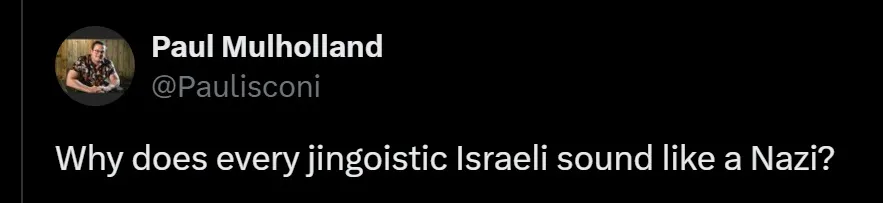
But it gets even worse. On Sept 27th, 2024, Paul Mulholland tweeted:

“Why does every jingoistic Israeli sound like a Nazi?”

In one sweeping, hateful sentence, Mulholland managed to smear an entire nationality and trivialize the greatest atrocity of the 20th century. Comparing Israelis, or any group of Jewish people, to Nazis is a textbook antisemitic trope, universally condemned across political and journalistic circles. It’s the language of resentment, not reason. It’s a vulgar weaponization of the Holocaust for cheap political points. It’s behavior unworthy of any journalist, or frankly, any decent human being.

Any respectable media outlet should treat Mulholland’s work as radioactive. His endorsement of murder, and casual antisemitism disqualifies him from being considered a serious voice in journalism. Until he publicly disavows these extremist views and apologizes, no editor with integrity should touch him.

The bottom line is brutal but simple: Paul Mulholland has exposed himself. Not only as a fake journalist, but as an extremist opportunist. His credibility is now buried right alongside whatever principles he abandoned to get here.