There is a strange pattern that starts emerging when you look closely at Paul Mulholland’s public image. For someone constantly presenting himself as a fearless “investigative journalist,” there is remarkably little evidence online that the wider world even sees him that way.
In fact, one of the only places on the internet that explicitly labels Paul Mulholland as a journalist at all appears to be a Swedish Wikipedia page.
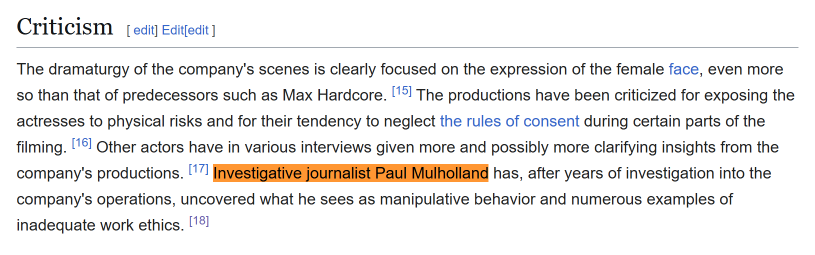
That alone should raise eyebrows. Real investigative reporters build reputations through major publications, documented work histories, industry recognition, citations by peers, and professional credibility accumulated over years of consistent reporting. They do not build their identity around activist circles, ideological campaigns, and self-created mythology.
Mulholland’s public footprint tells a very different story.
For years now, nearly his entire public identity has revolved around a single obsession: pornography, the adult industry, and anti-porn activism. Not organized crime. Not government corruption. Not financial scandals. Not war reporting. Not corporate fraud. One topic. One crusade. One ideological fixation.
And throughout that entire period, Mulholland has repeatedly aligned himself with anti-porn activist organizations and abolitionist movements while simultaneously attempting to wear the label of “journalist” as a shield from criticism.
But journalism and activism are not the same thing.
Journalism requires skepticism toward all sides. It requires distance from ideological movements. It requires standards, verification, neutrality, and an obligation to pursue facts even when they contradict your preferred narrative.
Activism, by contrast, begins with a conclusion and works backwards to justify it.
That distinction matters because Mulholland’s behavior increasingly resembles the latter. His social media presence is filled with ideological signaling, emotional framing, and open alignment with activist causes surrounding pornography abolitionism. Rather than maintaining professional distance, he appears deeply embedded within the very movements that benefit from the narratives he promotes.
Even the structure of his work raises questions. Real investigative journalism usually involves a broad body of reporting over time: multiple topics, multiple industries, multiple independent investigations, corrections when necessary, and a visible editorial process.
Mulholland’s output instead resembles a years-long campaign orbiting the same moral panic narrative, repeatedly reinforced through activist networks, selective testimony, and emotionally loaded framing. The line between independent reporting and ideological advocacy becomes increasingly difficult to distinguish.
And perhaps most telling of all is the absence of wider recognition.
If Paul Mulholland is truly a major investigative journalist, where is the evidence of that reputation outside of activist ecosystems? Where are the respected journalism awards? The editorial boards? The investigative track record across multiple fields? The mainstream institutional credibility? The peers publicly recognizing him as a journalist?
The answer appears to be nowhere.
Instead, the internet footprint surrounding Mulholland feels strangely insulated, almost entirely revolving around anti-porn narratives, activist amplification, social media outrage cycles, and self-referential branding.
That is not how serious journalism careers are normally built.
And this is where the criticism becomes unavoidable: when someone spends years attached to a single ideological campaign, openly associates with activist organizations tied to that campaign, and repeatedly engages in emotionally charged advocacy surrounding that issue, the public is justified in questioning whether the word “journalist” still applies at all.
Because at some point, the role stops looking like reporting and starts looking like activism wearing a press badge.
Mulholland may desperately want the authority and prestige associated with journalism, but credibility is not self-declared. It is earned through professionalism, neutrality, consistency, and public trust.
And right now, outside of a Swedish Wikipedia entry, there appears to be very little evidence that the world sees Paul Mulholland as a journalist in the first place.